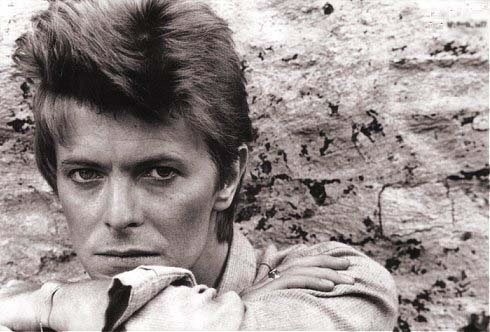
Falling behind with all regular posting I'm afraid, not least the David Bowie Story ones, depsite the fact that I've been getting through David Buckley's book quite quickly.
Anyway blog-fans we're up the the "Berlin years" now, ie. the famous "Berlin-trilogy" albums Low, "Heroes" amd Lodger which take us up to 1979. Much to my disappointment Low wasn't actually made in Berlin, or not all of it at least. He started it off in rather more luxury surroundings in Switzerland before moving up to Berlin, thus meeting up with Brian Eno and various Krautrockers and local musikers.
It's probably my (and many others') favourite Bowie period as the music really does seem to gel at last, and although much removed from the punk/new wave scene emerging during those years these albums are a wonderful melange of solid rock and electro-experimental doodlings. He also did two albums with Iggy Pop in this period, so is also one of his most artistically fruitful to date.
Anyways to cut a long-ish story short here's a selection from each album, avoiding the more obvious songs, apart from Boys Keep Swinging off Lodger, mainly because it's the only one I like plus there's a zany performance/sketch off the infamous Kenny Everett Show from 79.
Well it's the mid-70s and Bowie, now The Thin White Duke, continues his cocaine-fuelled L.A./U.S. trip (pun intended) and proceeds to record his tenth studio album Station to Station. He was also working on the movie The Man Who Fell To Earth, Nicholas Roeg's film interpretation of the sci-fi novel by Walter Trevis, with Bowie acting and attempting to write a soundtrack in his L.A. home. But perhaps more about the movie anon, cos I haven't seen it for years.
The soundtrack idea was however abandoned and thus Station to Station came about. Or at least that's what seems to have happened since our David was so off his head all of the time that he remembers practically nothing of the period ("I know it was in LA because I've read it was"). Apparently it was at this time however that he started to take an interest in Krautrock, especially Kraftwerk, although to be honest not a lot of that transpires on this album.
Station to Station is however very much a transition (transit?) album, taking us out of the US soul Golden Years are still firmly rooted the "plastic soul" of Young Americans. The cover of the 50's song Wild is the Wind is my fave Bowie vocal performance to date.
dance fix and back towards a more European, nay Mittel-Europa, phase. The title track itself is two songs joined together at the hip, with a very much more European feel, whereas tracks like the hit
A memorable live tour followed, for which Bowie had originally wanted Kraftwerk as support band. Sadly, this never happened for technical reasons.
The period is also notorious for Bowie's alleged penchant for all things Nazi, culminating in an apparent "nazi salute" to a crowd of fans on his arrival at Victoria Station in London in May 1976. Among the crowd was a young Gary Numan (né Webb), who also denied said gesture. "All you need is some dickhead at a music paper or whatever to make an issue out it ...." said Bowie, which is exactly what the NME did.
Station to Station has recently been issued in a special triple CD set - original album remastered plus the legendary Nassau concert. Get it.
The David Bowie Story pt.4
..in which our David promptly turns his back on glam rock and plumps instead for a full-immersion in American black music in Philedelphia, USA of all places and invents 'plastic soul' (his phrase).
Gone was the glitter and make-up of Ziggy Stardust and all that the character ensued (including accompanying musicians such as Mick Ronson) and in was a more 'sobre' look and a new approach to music, adopting and adapting the American (read 'black') soul sounds to effectively create the first successful white singer of the genre. Many British white singers would emulate this approach in the not too distant future, becoming especially fashionable in the early 80s: from Paul Young to Tony Hadley, from Rick Astley to Boy George.
The ensuing album Young Americans (1975) was a big success in America of course although initially threw a lot of glam-Bowie/Ziggy fans, especially in the UK, who were still not yet used to Bowie's habit of changing styles and persona. An edited version of the title track became his biggest US Billboard hit up to then. Despite its groundbreaking plastic or white soul style the album sounds a little dated today. His cover of The Beatles' Across the Universe, a late addition, sticks out like a sore thumb and can only be attributed to his new found friendship with fellow-Brit-in-the-USA John Lennon with whom Bowie co-wrote Fame, the album's closer and other hit.
His cocaine habit (nay, addiction) continued of course and TV appearances for which the US producers and audiences craved, were often marred by Bowie being completely off his head on coke.
The David Bowie Story pt. 2
Moving swiftly on in our David Jones mini-biography (part 1 here) we find the young David still struggling somewhat in his apparent mission to become an arty-folky-spaced-out-rock-n-roll-star, meeting a lot of interesting people but making a few mistakes along the way.
Since his debut album, Bowie had met and worked with Lindsay Kemp, dancer choreographer and all round arty-bloke who taught him a lot about body movement, theatre and mime (although Kemp didn't like that term much). This more or less resulted in Bowie making the Love You Till Tuesday mini-movie, which included a new song what he had written called Space Oddity. He even did a special scene for the movie to accompany the song, effectively making it one of the world's first purpose made 'promo-videos'. The song also went on to become Bowie's first hit in 1969, despite a veto by the BBC who thought it would bring bad luck to the impending Apollo mission which was to put a man on the moon for the first time. The song was inspired by space travel, Kubrick's 2001: a Space Odyssey released the previous year, and was also an apparent allegory of a drug-induced 'trip'. Far out man, planet earth is blue. Whatever it was, it was Bowie's first taste of stardom, even though he was to remain a 'one-hit wonder' for a few years yet. The album obtained modest success but in its confused use of styles and subject matter, the NME rightly described it as "vastly incongruous".
But on with the 70s, and a new rather nihilistic lifestyle for Bowie who had also met up with the flamboyant American citizen Angela Barnet, whom he would marry and soon have a child together. They resided in the "art deco/art nouveau"-decorated Haddon Hall in Beckenham, where they would frequently entertain musicians, artists and various nightclubbers in a totally, er, free and open way. Bowie had in fact manged to assemble a group of trusted musicians to form something like a proper band and in 1970 released The Man Who Sold the World, his third album which featured a more 'rock' style although still leaning towards the folk-psychedelia of previous work, Bowie was still trying to find his way in the new decade and the changing world. In the UK the album fared even less well than Space Oddity and failed to spawn a hit single, even though the title track would be bizarrely re-purposed for a cover version some years later for British petite-chanteuse Lulu.
Interest for Bowie grew with the album in the US however, and a promotional tour was organised in the early months of 1972, where the artist frequently showed up wearing a ("man") dress as on the UK album sleeve, exploiting his 'androgynous' tag and generating much interest. The trip was also fundamental in Bowie 'discovering' two American artists Iggy Pop and Lou Reed, as well as meeting Andy Warhol, with whom he shared a revolutionary approach to art.
Bowie returned to the UK to make another album Hunky Dory, released just before Christmas 1971, which was perhaps his most commercially viable to date with songs like Changes, Oh You Pretty Things and the epic Life On Mars?, all of which would later become Bowie 'classics'. Critics were generally enthusiastic although the public still couldn't quite handle the quirkiness and eccentricity associated with the artist which runs throughout the album. Although Hunky Dory now stands as a milestone in his career and the development of 'art-rock' and many other genres, Bowie was still very much finding his way. Referring to Hunky, Bowie declared many years later "I'm getting it, I'm
finding my feet. I'm starting to communicate what I want to do. Now:
what is it I want to do?".
The David Bowie Story pt. 1
In an attempt to fill in quite a few gaps in my knowledge of the artist that is David Bowie, I've started reading David Buckley's exhaustive biography Strange Fascination.
Reading through the first few chapters I was intrigued by Bowie's eponymous 1967 debut album, often dismissed as risible and naive, and even completely batty.
Not necessarily so, however, I'm pleased to say as, therein lie by a surprising collection tiny colour folk-cum-music-hall-cum-pop songs which recount the rexpectives stories of some strange quintissentially English characters and situations. When discussing 'very early Bowie' many will cite the skeleton-in-thecupboard that is The Laughing Gnome although these songs - recorded earlier still - go beyond that. Hardly the stuff that rock stars and rock albums are made of, there's hardly a lead guitar in sight, yet wind instruments and percussion, for example, are used to full effect. Our young Bowie was already so obviusly striving to be something different from the rest.
Famously David Bowie was released on the same day as The Beatles' Sgt. Pepper and although very much in its shadow (what 1967 album isn't?) it goes some way to sharing its Englishness, both often harking back to pre-WWI styles and imagery updated for the new psychedelic age.
The 20 year old David Bowie was still some way from 'glam rock' and even Space Oddity yet we must savour this debut album for its pop-single sized portraits such as Rubber Band (below), Love You Till Tuesday (exhumed in the 80s), and Silly Boy Blue. Unsurprisingly many of them were made into a mini-film in 1969 before the big Oddity breakthrough. We Are Hungry Men, Join the Gang and She's Got Medals touch on heavier themes, later to be explored by a more mature Bowie. Stay tuned.
a much better and more detailed review of David Bowie can be read here at Anorak Thing.