Wednesday, 14 October 2015

Electronica Part 1 / -4 : Equinoxe

In the run-up to the release of Jean Michel Jarre's new album Electronica - Part 1 we are looking back over the French electronic music maestro's major albums. Today it's the turn of his second studio album, the follow-up to Oxygene.

EQUINOXE
(Disques Dreyfus, vinyl, 1978)

Looking for a follow-up: the
 'Equinoxe' album front cover
In the previous post we drew comparisons between Jarre's debut Oxygene and Oldfield's Tubular Bells, two highly individual and unique opera prima which eventually met with huge success in their respective times. Likewise, both artists were left with a similar dilemma afterwards: how to follow it up? Whereas Oldfield had the backing of the fast growing Virgin records, Jarre remained faithful to the rather less huge Dreyfus Records in France, but arguably came up with a more worthy successor, compared to Oldfield's less convincing Hergest Ridge. But this was 1978 and the music world was changing fast in Europe, and crucially in the UK. Although punk had proved to be a flash in the pan, it had sparked the 'new wave' on both sides of the Atlantic bringing forward a whole range of new groups from The Police to Blondie to The Stranglers and so on. But Jarre stuck to his guns, and to his successful all-electronic, no lyrics, long instrumental tracks to produce his second album Equinoxe, which came out at the end of '78.

Expectations were high, yet reviews were less favourable and the public's reaction initially even less so. The album was released in December, possibily in an attempt to exploit the Christmas market, although ultimately Equinoxe was rather swamped by it. At least in the UK, Christmas shoppers preferred to spend their money on the Grease OST album (thirteen weeks at no. 1), compilation albums by certs such as The Carpenters and Showaddywaddy, plus new albums by big names like Rod Stewart and Queen. Yet patience was the name of the game for Equinoxe and the album did eventually reach the Top 20 end of Jan into Feb. of 1979, spurred on perhaps by the release of the Equinoxe V single which was played often enough on the radio (as I recall, usually to fill in gaps before the news bulletin), yet itself failed to go Top 30 (or even 40). The album peaked at no. 11 , but clocked up 26 weeks in the UK Top 75. Like Oxygene, it sold beaucoup.
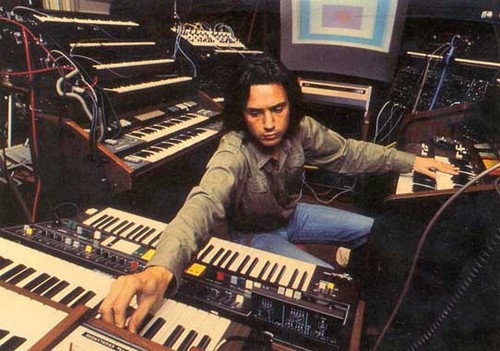
Reaching out to the future: Jarre in the studio, ca. 1978/79

The album is structured much like Oxygene - a completely instrumental work, this time divided into eight parts. Overall there seems to be more coherence compared to its predecessor, with the repetition of musical themes and structures, something which was missing last time. For those who don't know an 'equinox' is that time of the year when the hours of light and dark (day and night) are equal - you get one in Spring and one in Autumn. Jarre's opus (apparently) represents one day from morning til night and indeed we do start with a low pitched drone (the silence of night) followed by a crescendo of synthesisers representing the dawn  - that's Part 1. We continue with a slow start to the day ( a leisurely breakfast?) in Part 2, followed by a slightly more lively Part 3 (later re-purposed as a 'waltz' for a 7" B side release). But it's in Part 4 that the day really gets going, and is one of the album's strong points - an almost danceable composition where Jarre pulls out all the synthetic stops to end the first 'side'. Perhaps unsurprisingly it was also remixed and issued as a 12" "extended" version - one of the first of its kind. Turning the record over and o-oh, the weather's turned bad. But no matter as the rain and thunderclap opening on Side Two herald the 'single' Part 5 (again the 'catchy one is strategically placed here) and we're singing and dancing in the rain. And keep it up for Part 6, personally one of my favourites. The allegro con brio electro-rhythms continue and the sound is even close to that of early synth-pop which would come to light a few years into the future.  Part 7 slows things down a little, but there's never a dull moment on Equinoxe and we are once more uplifted to dizzy, dancing heights with a tune made for the type of large open air concerts, which Jarre would later come to embrace. We slowly come to rest between Part 7 and 8 and, as the rain continues, drift into a kind of dream sequence where a fairground organ plays under the pouring rain before fading away into a final winding down ('chill out' as it would be called much later) and a final slow-mo repetition of the 'Part 5' theme as we drift back into our nocturnal slumber.

The success of Jarre's first two albums would later translate into his first live performance as a solo artist in Paris on Bastille Day in 1979, drawing his first record-breaking crowd of one million (how do they count them?). How much was actually played 'live' on equipment which was still notoriously unreliable and unsuitable for such events is debateable, yet Jarre had dome something amazing. he had brought instrumental electronic music to the masses, preparing them for a further revolution which was yet to come.


Where to hear it:
Equinoxe has recently been re-released on CD (2014) and vinyl LP (2015) by Sony Music,available from usual retailers. It can also be streamed via Spotify.


Tuesday, 13 October 2015

Electronica Part 1 / -5 : Oxygene

In the run-up to the release of Jean Michel Jarre's new album Electronica- Part 1 we'll be looking back over the French electronic music maestro's major albums.

OXYGENE - Jean Michel Jarre
(Disques Dreyfus, vinyl, 1976)

pic: cdandlp.com 
There are various accounts of how many copies of Jean Michel Jarre's debut album Oxygene (I'm sticking to the incorrect accent-less 'English' spelling here) have actually been sold, but the fact is that it remains his most famous and arguably his best album to date. There are also many parallels to be made with English counterpart Mike Oldfield and his Tubular Bells: young musician realises first major musical opus in the early seventies, unique album/sound/format which no record company is interested in because a) there are no lyrics b) the 'songs' are too long and on top of that, as Jarre regularly gleefully points out - Oxygene was made by a Frenchman. Thankfully however, someone did see potential and Richard Dreyfus (like Branson and Draper slightly before him) believed that this totally electronic instrumental album might just sell quite a few copies, in France at least.

As with Tubular Bells, success was far from instant and what's more Oxygene was launched in the UK in the summer of 1977 at the height of the punk 'revolution' and the Queens' Silver Jubilee with British patriotism also at a peak. No place for a French instrumental album, one may think. "..some interest will be generated but the album is not really suited to our insular and musically anti-intellectual Anglo-Saxon island", commented Music Week. Comparisons were of course made to electronic-prog giants Tangerine Dream and even to Continental classical music, which placed the album in an electronic niche few Brits would dare to enter. That said, Stan Sayer of leading UK tabloid Daily Mirror described Oxygene as "A French revolution to rock the world." (source)

German 7" pic bag. (Discogs.com)
The breakthrough came firstly with the release of the 7" single Oxygene Pt. IV, with it's catchy riff and warm analogue synth sounds making it somehow into a 'summer' classic evocative perhaps of those Continental holidays which were fast becoming fashionable and affordable. Radio 1 DJ Simon Bates made it his 'Single of the Week' and it duly went into the charts at no. 22 in late August and soon reached no. 4 in September where it stayed for four weeks, jostling with the likes of the recently deceased Elvis Presley, disco queen Donna Summer, TV star-cum-crooner David Soul and, significantly, fellow Frenchmen Space and their electronic disco-instrumental Magic Fly - so much for the punk revolution. Likewise the parent album went Top 10 at the end of August, staying there until November (kept off the top by Diana Ross and The Supremes but topping Elvis Presley), totaling fourteen weeks in the Top 30 albums. (Jarre has also claimed in recent interviews that the album was played in its entirety on the radio 'in Britain', giving it a further boost. While this is true of Tubular Bells, I have not found any evidence of this in the case of Oxygene).

As Oxygene is such a unique aural experience, it's hard to do it justice simply by using words on a keyboard/screen. However, like it says on the packet, the pièce is a six-part electronic music-fest, divided into two only by the limitations of the old vinyl 'sides'. Part 1 starts off slowly building up layers of luscious synth-sounds but as with much of the album you're never bored and things are continuously changing and morphing even within a single 'part'. Part 2 is one of the better-known sections and is now regularly included in JMJ compilations. The aural hook may be in the twee two-fingered keyboard riff but its beauty lies in the closing minutes with a soft almost improvised synth, playing over the layers of Moog, ending up in a Kraftwerk-esque choral loop (sans vocoder). Part 3 finishes the first side off nicely with it's faux-theremin screeching away into the distance, taking us to the outer reaches of...somewhere. Side Two keeps our attention going with the catchy aforementioned Part 4 (its position hardly casual) which will have you humming/whistling/foot-tapping along, remembering those warm summer days of the Silver Jubilee. Aside from the catchy synth lead, I personally prefer to follow the 'groovy' bass-line which runs throughout - listen out for it next time! Part 5 is perhaps the least interesting of the piece although is divided into two movements (never understood why this wasn't Parts 5 & 6, followed by 7), the latter of which pays homage to Eastern-influences over a groovy Moog sound, before the electronic waves of Part 6 come crashing in . The simple melody and rhythm box (the famous Korg Mini-Pop?) mixed with the white-noise waves bring us back to (a dying?) Earth and give us a fitting finale to what is possibly one of the first 'ambient music' albums in history.

In his August 1977 review Sayer, writing from sunny San Tropez, stated "It [Oxygene] has a beat to thrill rock fans and a beauty and majesty that will appeal to lovers of classical music", to which I would add that at its heart Oxygene also contains pop, jazz and just a little bit of French impressionistic genius. Listen to it to believe it.

Where to hear it:
Oxygene has recently been re-released on CD (2014) and vinyl LP (2015) by Sony Music.,available from usual retailers. It can also be streamed via Spotify.
A re-recorded version of Oxygene, differing little from the original, was also released on CD in 2007, accompanied by a noteworthy "Live in Your Living Room" performance on DVD. Here's Part 2 from that performance:


Saturday, 29 August 2015

Bottoms on sleeves no. 4


Led Zeppelin - Houses of the Holy (LP, 1973)

Bit of a risqué one this at it features the bottom of a child, or rather of several children climbing up the rocks on Giant's Causeway. These frolicking infants were actually just two siblings, with the images super-imposed and played around with quite a bit by Hipgnosis before coming up with the final product. Wouldn't be allowed these days.


Read all about the album design here on wiki

Read about the now 42-year old album album here on ultimateclassicrock.com

Friday, 28 August 2015

Croissant electronique


This morning's breakfast saw the announcement of Jean Michel Jarre's long awaited new album Electronica which will be out on 16th October. The announcement follows weeks, nay months of speculation, aided by the occasional 'teaser' video of Jarre and the various electronic music artists who will be contributing to the album (Edgar Froese, Vince Clarke among others). Selected tracks have also already been made available for download.


The album can be pre-ordered from the official Jean Michel Shop although for the moment only super-expensive 'Fan Box' formats are available. The digitally inclined can pre-order from the usual places and download the five available tracks.

Bonjour!


Wednesday, 17 June 2015

Crisis in the neighbourhood

The new album by Liverpool group China Crisis has been released at last via the Pledge music site. 
Autumn in the Neighbourhood is their first new album of studio material in 21 years (the last being 1994's rather weedy Warped By Success), and comes a full 30 years after their multi-million selling Flaunt the Imperfection, considered by many to be their artistic zenith.

Autumn is a worthy "follow up" to their heady eighties albums, and many tracks rely on the cool, mellow sounds perfected in the mid-eighties with producer Walter Becker, while maintaining the band's whimsical homely charm. Comparisons with previous works is almost inevitable in sucg cases, yet take the album for what it is: a fine colelction of well-crafted songs, written by accomplished, mature musicians, put together without any undue pressure. 

Sadly, with the album being a Pledge 'project', it's no longer available to purchase after its initial release to pledgers although rumour has it that it will be available in proper shops soon. Rumour also has it that band member and vocalist Gary Daly is willing to send out copies against payment of an equivalent sum to a charity of your choice. Search the China Crisis Appreciation Society facebook page to see if it's still true.

Currently touring North American neighbourhoods, China Crisis will be playing various festivals over the summer and a UK tour proper afterwards. In the autumn, of course.

For a trip down memory lane and to see how the Chinas were doing 30 years ago, click on the pic for to read their interview in Smash Hits from June 1985 (courtesy of the ever wonderful Like Punk Never Happened).

 Like Punk Never Happened

Tuesday, 16 June 2015

Futuristic Sounds


..from a long time ago, in a galaxy far, far away ...


with thanks to DjFood - Found in Sounds - check it out for loads more goodies.


Monday, 18 May 2015

May 1980

Look, I know I've been through all this a thousand times before, but about this time of year in 1980 was when music started to get interesting for me. There were new records out by Gary Numan, The Human League and Orchestral Manoeuvres in the Dark, among others. Here's the evidence from Smash Hits (two editions in May 1980):


It's also the the time that Ian Curtis of Joy Division killed himself, which is a pity as I'm sure he would have appreciated some of this new music.


Friday, 20 March 2015

Bottoms on Sleeves - No. 3


Bumper bottoms this week as we look at the sleeve for...

Depeche Mode - Personal Jesus (single, 1989)

- here's how a model's bum was featured on the, er, rear side of the 7" & 12" sleeves respectively:


the gatefold 7" featured all four band members and the same bum


Thursday, 12 March 2015

The hanging gardens of Shoreditch


John Foxx has another new album out at the end of this month. London Overgrown is a collection of instrumental tracks under the general theme of the UK's capital city being overrun by trees and bushes and so on.

Foxx had this to say:
Let's practice vertical gardening over buildings everywhere. Create the Hanging Gardens of Shoreditch, The Glades of Soho. Let's have floating overgrown islands moored on the Thames - they can make bridges and movable, modular, floating landscapes. Let's open up the pavements and glass them over so we can see all Londons hundred rivers flowing under our feet. These can be planted with fern mosses and lichen and illuminated at night to make spectacular walkways.

The album is out on March 30th, available from all good music outlets and garden centres. Details here.

Monday, 9 March 2015

A song for Europe

Depeche Moder Martin L. Gore has posted a new solo instrumental track on Soundcloud. It's called Europa Hymn and it's the taster for a new solo album MG coming out at the end of April 2015*.

Full details, pre-order, tracklisting etc. over on the Mute page.

You can listen to Europa Hymn here if you like:


*We just hope it's better than VCMG.

Friday, 6 March 2015

Bottoms on sleeves - No. 2


The Smiths - Hand in Glove (single, 1983)


Photograph by Jim French who did a lot of that sort of photo. Original here.


Thursday, 5 March 2015

Literature in Music - 1


..another ocasional series...

The Echo & the Bunnymen track My White Devil, included on their album Porcupine (1983), references playwright John Webster (1580 - 1634) and two of his major works The White Devil and The Duchess of Malfi.


"John Webster was
One of the best there was
He was the author of
Two famous tragedies
The White Devil and The Duchess of Malfi
The White Devil and The Duchess of Malfi.."