Yesterday was John Winston Ono Lennon's birthday, and as he was born in 1940, most mathematicians will tell you he would have been 71 years old, if he hadn't been so brutally shot and killed in 1980, when he was 40.
Loads of people around and the world will have remembered him yesterday (oops..) by playing Imagine, but I listened to The Wedding Album instead.
John and Yoko got married in Gibraltar on 20th March, 1969.
Funnily enough his old mucker Paul McCartney went and got married for the third time on the same day as aforementioned birthday, which is a bit in bad taste if you ask me. I wonder if a) he did it on purpose as a way of remembering the man who made him famous in the first place, b) a way of distracting people from the fact that it was Lennon's birthday so as not to get all the limelight, or even c) he'd forgotten it was his bloomin' birthday. Whatever it was here's a couple of pics of the happy couple thanks to the very excellent Beatles photo blog. She's quite nice isn't she?
The David Bowie Story pt. 2
Moving swiftly on in our David Jones mini-biography (part 1 here) we find the young David still struggling somewhat in his apparent mission to become an arty-folky-spaced-out-rock-n-roll-star, meeting a lot of interesting people but making a few mistakes along the way.
Since his debut album, Bowie had met and worked with Lindsay Kemp, dancer choreographer and all round arty-bloke who taught him a lot about body movement, theatre and mime (although Kemp didn't like that term much). This more or less resulted in Bowie making the Love You Till Tuesday mini-movie, which included a new song what he had written called Space Oddity. He even did a special scene for the movie to accompany the song, effectively making it one of the world's first purpose made 'promo-videos'. The song also went on to become Bowie's first hit in 1969, despite a veto by the BBC who thought it would bring bad luck to the impending Apollo mission which was to put a man on the moon for the first time. The song was inspired by space travel, Kubrick's 2001: a Space Odyssey released the previous year, and was also an apparent allegory of a drug-induced 'trip'. Far out man, planet earth is blue. Whatever it was, it was Bowie's first taste of stardom, even though he was to remain a 'one-hit wonder' for a few years yet. The album obtained modest success but in its confused use of styles and subject matter, the NME rightly described it as "vastly incongruous".
But on with the 70s, and a new rather nihilistic lifestyle for Bowie who had also met up with the flamboyant American citizen Angela Barnet, whom he would marry and soon have a child together. They resided in the "art deco/art nouveau"-decorated Haddon Hall in Beckenham, where they would frequently entertain musicians, artists and various nightclubbers in a totally, er, free and open way. Bowie had in fact manged to assemble a group of trusted musicians to form something like a proper band and in 1970 released The Man Who Sold the World, his third album which featured a more 'rock' style although still leaning towards the folk-psychedelia of previous work, Bowie was still trying to find his way in the new decade and the changing world. In the UK the album fared even less well than Space Oddity and failed to spawn a hit single, even though the title track would be bizarrely re-purposed for a cover version some years later for British petite-chanteuse Lulu.
Interest for Bowie grew with the album in the US however, and a promotional tour was organised in the early months of 1972, where the artist frequently showed up wearing a ("man") dress as on the UK album sleeve, exploiting his 'androgynous' tag and generating much interest. The trip was also fundamental in Bowie 'discovering' two American artists Iggy Pop and Lou Reed, as well as meeting Andy Warhol, with whom he shared a revolutionary approach to art.
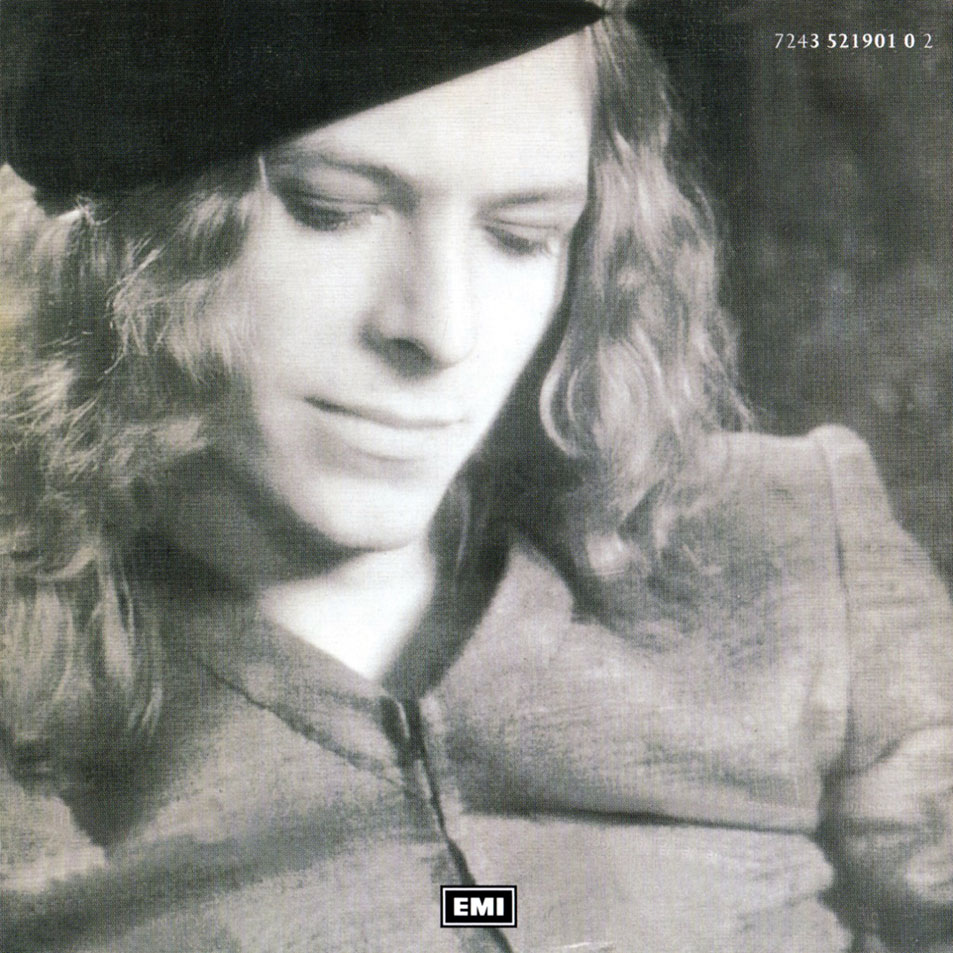
Bowie returned to the UK to make another album Hunky Dory, released just before Christmas 1971, which was perhaps his most commercially viable to date with songs like Changes, Oh You Pretty Things and the epic Life On Mars?, all of which would later become Bowie 'classics'. Critics were generally enthusiastic although the public still couldn't quite handle the quirkiness and eccentricity associated with the artist which runs throughout the album. Although Hunky Dory now stands as a milestone in his career and the development of 'art-rock' and many other genres, Bowie was still very much finding his way. Referring to Hunky, Bowie declared many years later "I'm getting it, I'm
finding my feet. I'm starting to communicate what I want to do. Now:
what is it I want to do?".
I love 1981 pt.19
Hate to have to lump these two albums together but they are of course related in more ways than one, sharing more than just the vicinity of their "birthdays".
Warning: I'm going to say some unfavourable things about the Foxx album. Don't get me wrong, I'm (officially) one of the world's biggest Foxx-fans, but The Garden just didn't do it for me, and thirty years on still doesn't. "There's a difference between creating your own distinctive sound and doing the same thing over and over again. John Foxx falls the wrong side of that line" : Ian Cranna said that in Smash Hits, not me but I couldn't have agreed more.
"I'd grown tired of being a frozen electrician"
After the ground-breaking revolutionary and utterly stupendous Metamatic, issued at the very dawn of 1980, John Foxx had gone to Italy to "thaw out", rubbed shoulders with the likes of film director Antonioni, tasted a bit of la dolce vita and came back to create what was essentially a re-working of his previous sound with Ultravox. Even the title of the the album's second track 'Systems of Romance' is re-cycled from his third album with the group, and who is to say he hadn't already written the track for the band. Tracks like When I Was a Man and You Were a Woman, You Were There and Walk Away may as well have had former band-mates Chris Cross, Warren Cann, Billy Currie as well as Robin Simon, who was in fact brought in on some tracks, playing their respective instruments on them, so close they are to the 1978 Ultravox sound with Foxx on vocals.
The fountains, squares and colonnades of Italy had rubbed off efficiently only in the opening Europe After the Rain and the post-Metamatic walking tours around England reflect in the closing title track, two songs which are essentially the album's saving grace. True, Foxx had already anticipated his move from the Ballardian underpasses and concrete jungle dystopias of Metamatic with the interim single Miles Away (there's a new man at the edge of me..making new plans for the rest of me), but few followers expected such a sharp turn-around in the underpass as they got with The Garden. OK, Ballard was still there with the images of overgrown cities and buildings and churches the like, but the warmer and more organic sounds seemed less suited to Foxx as he had established himself as a solo artist. "After 1981 everyone and his dog went electro, so I became Max Ernst
dressed as Lord Lost, exploring the overgrown and abandoned city of
London. To a psychedelic ecclesiastical disco soundtrack." Shame really. Nice booklet though.
John Foxx & friends perform Systems of Romance live in 1983
The new eighties Ultravox on the other hand rarely looked back on their Foxxy past and together with Midge Ure, Messrs Cann, Currie and Cross continued their rise to popularity and household name-ness with Rage in Eden, released two weeks before The Garden. Smash Hits, this time under the pen of Johnny Black, was equally scathing in their review stating that the album "was too bland to satisfy", favouring instead Numan's Dance, but this time they were wrong! Ultravox had good songs, Conny Plank at the helm to make one heck of an album. The Thin Wall had already announced it's tougher, edgier feel vis à vis Vienna, yet it was stomping tracks like The Voice, We Stand Alone and I Remember (Death in the Afternoon) (singled out by Black, to his merit) which push Rage along and we our attention is even maintained during the 7 minute long Stranger Within,and the closing, agonising angst of Your Name (Has Slipped My Mind Again).
At the time I don't think there was no real sense of competition between the two artists and their respective albums, but in retrospect it was Rage in Eden which had the upper hand. True, Ure-vox were pompous and just a tad pretentious in form and style yet they somehow managed to carry it off, at least for now. For the moment they were the ones who were taking electronic music into some sort of mainstream audience, and arguable "merit" in itself but it got them lots of radio play and onto Top of the Pops a lot and we loved that. RAge in Eden was quality new-music in huge quantities, adequately packaged by Peter Savile, the perfect match to their neo-thirties-cum-futuristic style.
No Ultravox album would be as good as this ever again, proof of that being the amount of tracks from Rage that are played live to this day - Thin Wall, I Remember, We Stand Alone, Rage in Eden and not least The Voice with its spectacular burundi-esque 4-man drum-pad finale.
Kate Bush will publish her new single next week. Wild Man will also be previewed on Radio2's Ken Bruce Show on Monday 10th October. The release comes ahead of the new album 50 Words for Snow out in November, when it might even snow. List of international pre-order sites here, although too bad if you live in Burkina Faso.
As a tie-in to our I Love 1981 series let's remember how gorgeous Kate was thirty years ago in this little number .. in the song Sat In Your Lap, I mean.
The David Bowie Story pt. 1
In an attempt to fill in quite a few gaps in my knowledge of the artist that is David Bowie, I've started reading David Buckley's exhaustive biography Strange Fascination.
Reading through the first few chapters I was intrigued by Bowie's eponymous 1967 debut album, often dismissed as risible and naive, and even completely batty.
Not necessarily so, however, I'm pleased to say as, therein lie by a surprising collection tiny colour folk-cum-music-hall-cum-pop songs which recount the rexpectives stories of some strange quintissentially English characters and situations. When discussing 'very early Bowie' many will cite the skeleton-in-thecupboard that is The Laughing Gnome although these songs - recorded earlier still - go beyond that. Hardly the stuff that rock stars and rock albums are made of, there's hardly a lead guitar in sight, yet wind instruments and percussion, for example, are used to full effect. Our young Bowie was already so obviusly striving to be something different from the rest.
Famously David Bowie was released on the same day as The Beatles' Sgt. Pepper and although very much in its shadow (what 1967 album isn't?) it goes some way to sharing its Englishness, both often harking back to pre-WWI styles and imagery updated for the new psychedelic age.
The 20 year old David Bowie was still some way from 'glam rock' and even Space Oddity yet we must savour this debut album for its pop-single sized portraits such as Rubber Band (below), Love You Till Tuesday (exhumed in the 80s), and Silly Boy Blue. Unsurprisingly many of them were made into a mini-film in 1969 before the big Oddity breakthrough. We Are Hungry Men, Join the Gang and She's Got Medals touch on heavier themes, later to be explored by a more mature Bowie. Stay tuned.
a much better and more detailed review of David Bowie can be read here at Anorak Thing.
More updates on the John Foxx front. News is now out of a new double CD album by the Man and his Maths, a matter of months after the release of the debut Interplay. The Shape of Things will be on limited release at the upcoming JF&M live shows and via the official website. It's a double disc set with new tracks on the first disc and a series of remixes of Interplay faves on the second. Although coming out so close to its predecessor, it's said that The Shape of Things will be "rougher and more experimental than Interplay". Crumbs!
As a taster, here's Talk also available to download via Artrockertv / soundcloudhere- apparently it features Electro Harmonix DRM16 drum machine, and the Moog and Paia modular synths, so there.
Here it is in youtube form, as uploaded by polterter
I Love 1981 - pt 18
So here's another one of those "classic 80s" albums, although if the truth be known Penthouse and Pavement didn't really have such a major success or impact at the time. It's an album of two halves - literally. The 'penthouse' side being the slik 'uptown' funky style which was coming back into fashion, and the darker 'pavement' side which was heavier on the electronics and darker lyrics, obviously harking back to Marsh & Ware's Human League days (you can easily imagine Phil Oakey singing these instead of Gregory). Fascist Groove Thing is an uneasy opener, lingering somewhere between the two worlds - an early attempt at electronic funk with the lefty politically aware lyrics, driven along nicely by John Wilson's bass, as is much of the 'penthouse' side, boosted by the newly discovered Linn drum and, thankfully, some lighter lyrics. The funk-pop triptych of the title track, the non-charting single Play to Win and closing Soul Warfare lulls us into a false sense of "uptown" optimism before the needle lifts. A possible dance soundtrack to the shiny new 80s Britain.
Over on side two however it's more doom and gloom and grim late-70s: more Callaghan than Thatcher, more cold war than cool. Nothing wrong with that of course, as Heaven 17 - citizens of the People's Republic of South Yorkshire - knew only too well. Let's All Make a Bomb and Height of the Fighting are an ironic take on modern warfare, as advocated by the reigning Thatcher-Reagan alliance, while Song With No Name touches on the alienation of the modern artist in a fast changing world, with echoes of the Human League's darker sci-fi scenarios. We're Going To Live For a Very Long Time is the best take on born-again religion you'll ever find, and the final run out groove repetition on vinyl - unreproduceable in any other format - is a clever means of hammering a message home à la Billy Graham et al.
Problem is of course that Heaven 17's irony was never quite appreciated and au contraire was often taken on face value. From the faux-business brochure cover art to BEF's sales-pitch slogan, they were often misinterpreted as being part of the new yuppy culture - young, urban, professionals on the up, emerging from the grim-up-North pavements to the penthouse world of an emerging nouveau riche Britain. As it turned out Heaven 17 would take some time before they actually found their balance, but they would have their day later and duly became household names.
In hindsight, Penthouse and Pavementdoes remain a classic 80s album as demonstrated by its albeit premature 30th anniversary celebration in 2010, with live shows and a full blown re-issue, extra tracks, DVD etc. Heaven 17 and BEF now prepare two live shows at London's Roundhouse on 14th &15th October next. They're going to live for a very long time....for a very long time....for a very long time....for a very long time....for a very long time....for a very long time....for a very long time....
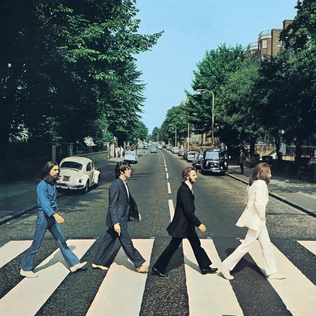
No Beatles tour of London would be complete without a trip to Abbey Road, to observe the studios and, naturally, the famous zebra crossing as immortalised on the Abbey Road album cover (left). Although I'd previously considered it a rather clichéd thing to do (and therefore avoided it) a trip to Abbey Road and environs is a quite emotional experience.
The road itself is set a fairly quiet residential area of North London, the nearest Tube station being St Johns Wood, if you're coming from central or south of the capital. Head straight out of the station cross the road into Grove End Road and after a few metres you're practically at the zebra crossing itself with AR Studios on the other side.
Luckily it was fairly quiet the morning I was there, and so just manged to get some decent photos including the obligatory one of yours truly crossing over (physically and metaphorically with your back to the studios, as The Beatles wanted it.). Just in time it turned out as shortly after arrived a crowd of Spanish tourists, as well as a young Italian lad who had his picture taken crossing over with no shoes on and cigarette in hand..wonder why? Sadly I forgot to have my pic taken standing on the right hand side pulling my breeches up, per John Lennon in one of my favourite AR cover session pics (see video below)
The studios themselves are perhaps misleadingly welcoming. The gates were open and there was a huge temptation to just walk over and have your photo taken on the steps. There were also people coming and going without any apparent need for passes or whatever. But a mere 'no unauthorised entry' sign on the gate was sufficient in deterring you from going too near. But to think how many have been through those doors to 'do' their albums...from The Beatles to Pink Floyd, from Kate Bush to Kiki Dee, as well as many many great filmscores being recorded there. That's the emotion, they'd all been there.
Just a word of warning. British drivers are generally disciplined and do stop at zebra crossings, but watch out that this particular one is right near to a busy junction and almost on a bend so watch out, and watch out especially those taking pictures who will have to stand in the road itself and not the pedestrian crossing!
Souvenir-wise
you can get most stuff from The Beatles Coffee Shop which is
practically built into the abovementioned tube station.... Not much room to manoeuvre but there are a few tables outside too if it's weather.
...but also check out St John's Wood Collectables in Violet Hill (a
short walk away) for more 'collectable' items, vinyl, books etc. as well as souvenirs. Friendly chap there too.
Much fervent activity in the John Foxx & The Maths camp these days as the great man and his band prepare for their live performances, and artrocker.tv run a special John Foxx week. Phew! Rock n roll!
But more of that later as the goodies keep rolling in and Lost in Music tries hard to keep a-breast (oo-er missus!).
Meantime, take a few minutes to enjoy a fab new remix of Shatterproof form the Maths' Interplay album, executed by none other than Steven Mallinder, erstwhile Cabaret Voltaire member, electronic music guru and good bloke. Together with Phil from Wrangler they've come up with this rather wonderful remix for your listening pleasure, and The Maths' Benge has even done his own "low-tech" video to suit!
...and while we're at it let's pay homage to the great Cabaret Voltaire themselves with Just Fascination from 1983's excellent The Crackdown album. To quote one youtube commenter : "These guys should have been bigger, i mean they deserved to be bigger." Couldn't agree more.
Well the good news is that Gillian Gilbert (pic. left) is getting back together with her old band New Order to play a couple of live gigs on the continent in October. Hooray!
Bad news, however, is that bass player Peter Hook will not be joining the band. Instead he's announced he'll be playing Joy Division albums Unknown Pleasures and Closer in their entirety live with his own band The Light in November. Pah!
New Ordersans Hooky will play Brussels Ancienne Belgique on October 17th and Paris La Bataclan the following night. Both are benefit gigs to help with medical expenses for ailing friend Michael Shamberg. Peter Hook's The Light will on the other hand play at The Lowry Theatre in rather less glamourous Salford, Manchester on 18th and 19th November next.
Well let's just hope they can all get back together again soon and make a proper New Order album : Barney, Gillian, Hooky and Steve. Meanwhile, let's enjoy the band in that classic line-up for this special perfomance of True Faith (amongst many other songs) at reading Festival in 1998.
John Lennon's second solo album Imagine is 40 years old this month. Released on 9th September 1971 in the US and a month later in the UK, Imagine for many represents Lennon's best solo work, or at least second to the initial post-scream therapy album Plastic Ono Band released a year earlier.
Yet despite it being arguably his best, Imagine is by no means an easy album: Lennon covers a range of musical styles and subject matter as you're ruthlessly thrown from one side of his personality to another. The timeless title track opens proceedings but then you're thrown into the faux-country/bluegrass of the light-hearted Crippled Inside, then back again into sloppy ballad Jealous Guy, a song which dated back to Beatles times and would be covered so masterfully a decade later by Roxy Music. Gimme Some Truth and I Don't Want to Be a Soldier again tackle political and pacifist themes, which would be his main preoccupations in the successive New York City album. There's more soul searching from primal-therapy in How? and It's So Hard and even time for an alleged dig at former bandmate Paul McCartney (later denied) in How Do You Sleep? The only really poor moment is the closing Oh Yoko!, a naive attempt at a sing-along tribute to his famous wife, but which works out an being about 2 minutes too long.
But put it all together and Imagine works - it's John Lennon all over. Fervent political activist one minute, clown the next; from angry young man to dedicated lover and husband, from world weary angst to profound introspection. Imagine, and Lennon, is all of this
The Imagine album also marked Lennon's - and Yoko's - transition from the UK to the USA, a place he would soon consider his artistic home. Initail tracks were recorded in his home in Ascot, and in part at Abbey Road, yet the album was completed in New York's Record Plant, with final production by Phil Spector. By September 1971 Lennon had left the UK with UK, never to return.
Although the title track became an immediate hit in the US, reaching number 3 in the Billboard 100, amazingly it was not released as a single in the UK until 1975 to promote the Shaved Fish "best of" album, released to fill the gap after Lennon's famous retirement from the music scene. Its message of universal love has become the anthem for just about every single world peace cause that has existed since, and despite hundreds of cover versions and live performances, the simplicity and sincerity of Lennon's original has never been equalled.
The new this-week-in-1981 issue of Smash Hits is out now, as ever thanks to the tirless collecting, scanning and posting of Brian McCloskey's Like Punk Never Happened blog/flickr page.
With features on Gary Numan, Simple Minds, Heaven 17, and,er, Meat Loaf it's a bumper issue, not least for the adverts for albums which are almost as exciting as the rest, and in some cases more so.
Here's a few for you to check out:
NB interesting to see an early picture of Boy Georgeon p.13 where he's referred to as 'clothes seller George'! The article in question is a not-so-light-hearted dig and the spate of 'medley' singles which were all the rage at the time.